MAIN MENU
SEARCH
Services

Landlords

Tenants

Brokers

Vendors



Owning property in Dubai can be a valuable long-term investment, but successful ownership involves much more than collecting rent.
Landlords have to manage tenancy contracts, Ejari registration, rental increases, maintenance, tenant relationships, documentation, property valuations, rent collection and regulatory obligations. For owners living outside the UAE or managing multiple properties, keeping track of everything can quickly become difficult.
This is where technology can make property ownership more organised.
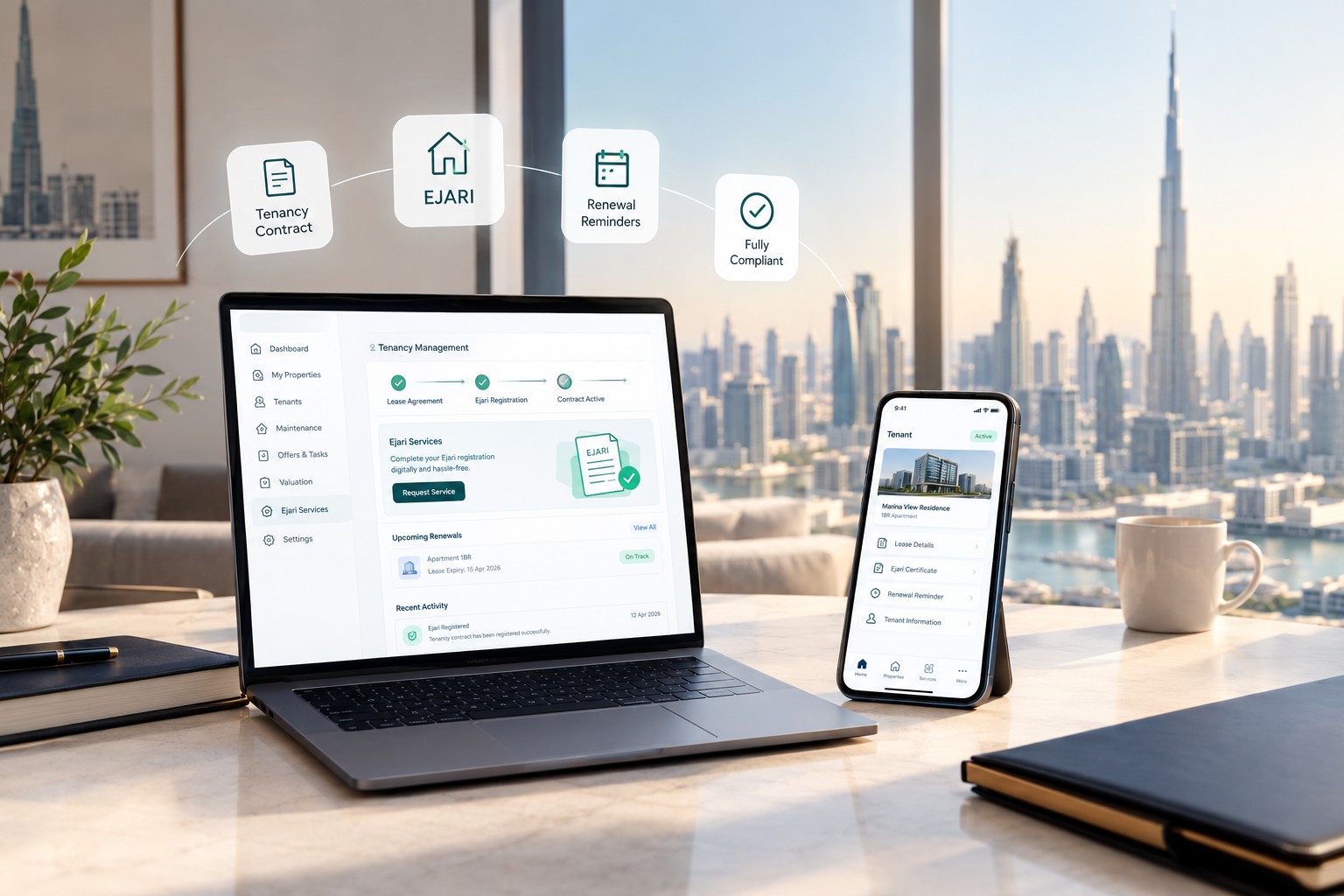
BSO Club, developed as part of the BSO Real Estate Management ecosystem, brings property-related services, communication, tasks and management into one digital environment. Instead of managing every requirement through separate phone calls, emails, spreadsheets and service providers, landlords can use BSO Club to manage and request services digitally.
But what does that actually mean for a Dubai landlord?
Property ownership comes with responsibilities that can directly affect both the financial performance and long-term condition of an asset.
A landlord may need to keep track of:
Dubai's regulatory framework provides specific procedures for many of these areas.
For example, Ejari is the system used to register tenancy contracts in Dubai, helping formalise the landlord-tenant relationship and maintain an official record of the tenancy.
Similarly, landlords cannot simply increase rent by choosing any amount they want. Dubai's Rental Index provides a mechanism for determining the applicable rental increase based on factors including the property's current rent and market conditions. DLD states that the landlord or tenant generally needs to notify the other party at least 90 days before the tenancy contract expires if they want to amend rental terms, unless otherwise agreed.
For a landlord, therefore, good property management is partly about knowing what needs to happen and partly about making sure it happens on time.
According to BSO, landlords can add their property, connect with brokers, request services and track property-related activities through the platform. The ecosystem includes services such as tenant finding, property maintenance, Ejari-related services, property valuation reports, rental dispute assistance and digital offer and task management.
This creates an important distinction.
BSO Club is not a replacement for Dubai's regulatory authorities. Instead, it is designed to help property owners organise and access the services involved in managing their real estate assets.
That distinction matters because legal compliance ultimately depends on the applicable laws, regulations and official processes.
Tenancy documentation is one of the most important parts of rental property management in Dubai.
DLD's Ejari system provides the formal registration framework for tenancy contracts. DLD also provides digital services relating to tenancy registration, certificates, rental calculations and other tenancy procedures.
For landlords, the challenge is often not understanding that documentation matters. It is keeping track of everything throughout the tenancy lifecycle.
BSO Club incorporates Ejari-related services into its digital property ecosystem, allowing landlords to request relevant services while keeping their property-management activities more organised.
This can be particularly useful when an owner has multiple properties or lives outside Dubai.
Rental increases are another area where landlords need to distinguish between market assumptions and regulatory requirements.
Dubai's Rental Index allows users to calculate rental increases and review average rental values based on information such as the property's location, type, number of rooms, current annual rent and contract details.
DLD's Smart Rental Index also considers factors such as building classification and the relationship between the current rental value and average market rent. Under the framework announced by DLD, permitted increases can range from 0% to 20%, depending on how the current rent compares with the applicable average market rent.
For landlords, this means rental decisions should be based on the applicable official calculation and required notice periods—not simply on what another property is charging.
Property maintenance is not simply an operational expense.
A neglected maintenance issue can affect tenant satisfaction, property condition and potentially the long-term value of an investment.
DLD's tenancy guidance states that, unless otherwise agreed, landlords are generally responsible during the tenancy for maintenance and repairs that affect the tenant's intended use of the property.
This makes maintenance management an important part of responsible property ownership.
Through BSO Club, landlords can request on-demand maintenance and access property-related service providers through the ecosystem. BSO also describes maintenance coordination as part of its property-management offering.
Instead of keeping separate records for every technician, repair request and follow-up, the goal is to bring more of this activity into a central digital workflow.
A landlord needs more than a tenancy agreement to understand how a property is performing.
You also need visibility into:
Rental income → expenses → maintenance → occupancy → valuation → overall property performance
BSO Club is designed to give landlords a centralised view of property-related activities, including property services, offers and management tasks. BSO also promotes portfolio tracking and property valuation services through the platform.
This is particularly relevant for investors with multiple properties.
Rather than treating every unit as a separate administrative project, landlords can build a more structured approach to managing their portfolio.
Finding tenants is another major responsibility for landlords.
BSO says its ecosystem connects landlords with a network of registered real-estate professionals and enables landlords to list properties and interact with brokers digitally.
Its tenant-finding service also describes a process involving property evaluation, targeted advertising through its brokerage network, tenant screening, lease finalisation and move-in support.
For landlords, the benefit is not simply having another place to advertise a property.
The bigger advantage is having property listing, broker communication, offers and related management activities connected within the same ecosystem.
One of the biggest problems with traditional property management is fragmentation.
A landlord might have:
Individually, none of these systems is necessarily a problem.
Together, they can become difficult to manage.
BSO Club is designed around a different approach: bringing property services, offers, communications and tasks into a digital ecosystem. BSO describes features including digital offers, task tracking, built-in communication and access to multiple property-related services.
That creates a more organised operating layer around the property.
The real value of a property-management platform is not simply putting services into an app.
It is creating visibility.
A landlord should be able to understand:
What is happening with my property?
What needs my attention?
Which services have been requested?
What offers have I received?
When does my tenancy need attention?
What maintenance is outstanding?
What is my property worth?
BSO Club is designed to help answer these questions within one digital ecosystem.
For overseas landlords, this type of digital access can be particularly relevant because physical distance makes traditional property management more difficult. BSO specifically positions its property-management services for overseas landlords and busy property owners who need local support.
Dubai's real estate market operates within an increasingly digital regulatory and service environment. DLD itself provides digital channels for services including Ejari, rental information, valuation and other property-related processes.
For landlords, the next step is not simply owning property digitally.
It is managing the ownership experience digitally.
That means having better visibility over documentation, tenants, maintenance, rental activity, brokers, offers and property services.
BSO Club brings these elements together through a single digital ecosystem built around the property owner's needs.
It does not replace Dubai's laws, DLD, RERA or official procedures. Instead, it provides a technology-enabled way to organise and access many of the services that landlords need throughout the property lifecycle.
A Dubai property is a financial asset—but managing that asset requires continuous attention.
Legal compliance, tenancy administration, maintenance, rental management, documentation and financial oversight all contribute to how efficiently a property is managed.
For landlords who want a more organised approach, BSO Club combines property management, real-estate services, broker connectivity and digital task management in one ecosystem.
Instead of treating property management as a collection of disconnected tasks, BSO Club aims to make it a more structured, visible and digital process.
Your property may be an asset. Managing it properly is what helps protect that asset.
.avif)
.avif)
.avif)
.avif)
.avif)
.avif)
.avif)
.avif)
.avif)
.avif)
.avif)
.avif)

.avif)
.avif)
.avif)
.avif)

.avif)
.avif)

Professional property management in Dubai has been taken to a new standard by BSO® (Be Simply Organized), which provides UAE landlords with outstanding opportunities.
Download BSO Club now!