MAIN MENU
SEARCH
Services

Landlords

Tenants

Brokers

Vendors



Ask most first-time investors what changes when they move from a residential apartment to a commercial or retail unit, and the answer they expect is "not much — it's still just renting out a property." In practice, almost everything changes: the contract structure, the legal protections available to each side, the tax treatment, the negotiation dynamics, and what "management" even means day to day.
Both property types sit under the same foundational law — Law No. 26 of 2007, as amended by Law No. 33 of 2008 — but the way that law applies, and how much room it leaves for negotiation, diverges sharply once you cross from residential into commercial or retail space. Understanding that gap matters whether you're an investor deciding which asset class to buy, or a landlord who already owns one type and is now considering the other.
Residential tenancies in Dubai are built around standardization and tenant protection. Leases follow a largely fixed format, rent increases are capped by the RERA Rental Index, notice periods for eviction and rent changes are set by law, and there's relatively little room for either party to negotiate away those protections.
Commercial and retail leases work on a different assumption entirely: both parties are treated as sophisticated business entities capable of negotiating their own terms, so the law affords them considerably more contractual freedom. A commercial lease is a bespoke, negotiated document — rent structure, escalation clauses, fit-out obligations, exclusivity terms, and renewal rights are all points of negotiation rather than fixed defaults.
This single distinction explains most of what follows.
In a residential lease, rent increases follow the RERA Rental Index almost automatically — the landlord checks the market gap, applies the corresponding percentage band, and serves 90 days' notice. There's little room for creative structuring.
Commercial and retail rent works very differently:
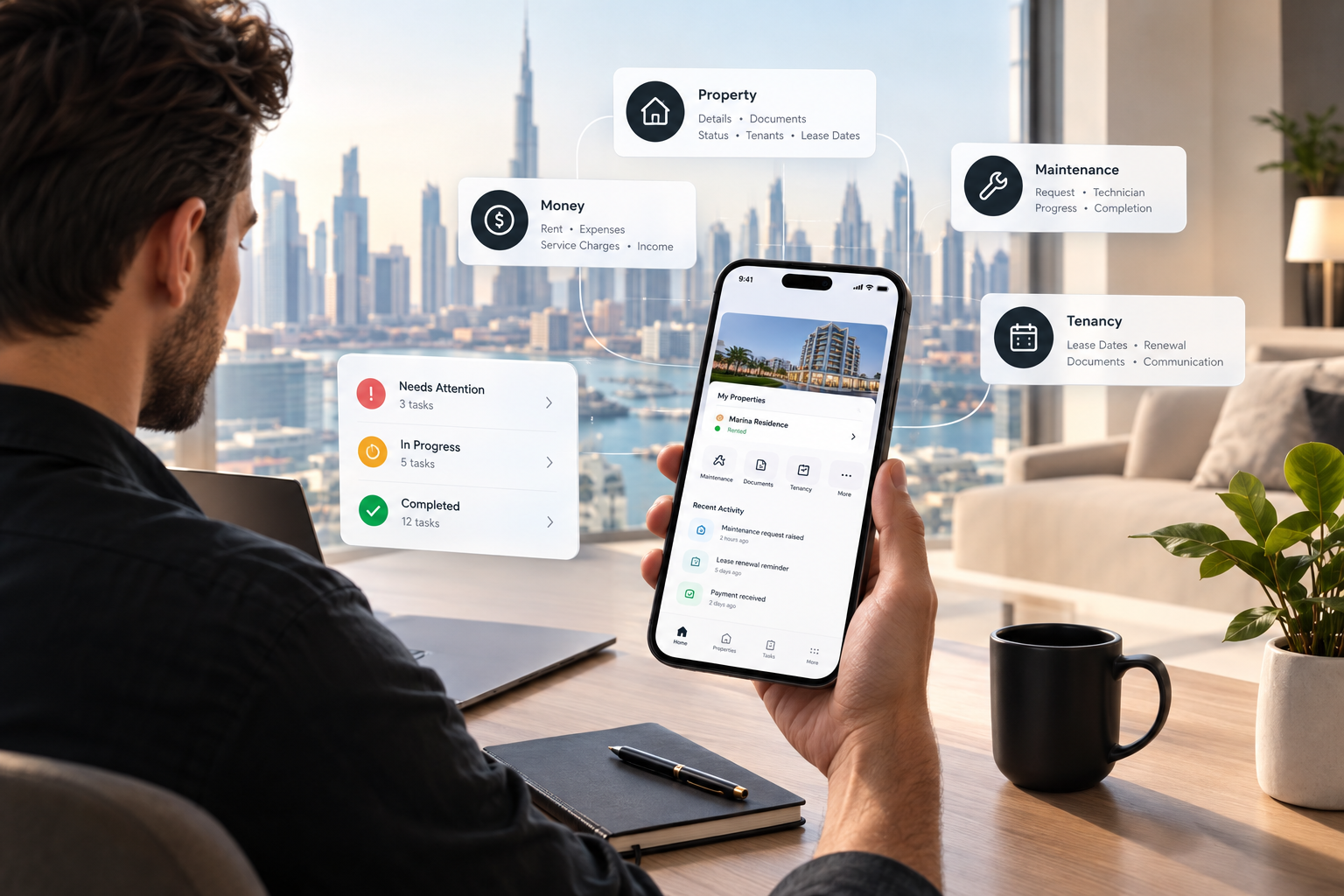
For a retail landlord, this means rent isn't just a number to collect — it's a structure that has to be actively negotiated, monitored, and in turnover-rent cases, reconciled against the tenant's actual sales performance. This is one of the areas where BSO Club earns its keep on the commercial side: instead of manually cross-checking sales reports against a turnover-rent clause every quarter, landlords can track escalation schedules, benchmark data, and reconciliation figures for each unit from a single dashboard.
The underlying legal principle carries over from residential: under Law No. 26 of 2007, the landlord remains responsible for property maintenance and structural repairs unless the lease explicitly states otherwise, and that obligation for structural or latent defects generally can't be shifted to the tenant.
What changes is the scale and complexity of what "maintenance" actually covers. A residential unit might involve an AC unit, plumbing, and basic electrical systems. A retail unit or office floor can involve shared HVAC serving multiple tenants, fire and life-safety systems, service-charge reconciliation across a whole building or mall, common-area upkeep, and — in serviced offices or business centers — a "managed lease" model where the landlord handles most maintenance directly and passes the cost through the service charge, with the tenant only responsible for the interior fit-out and compliance with building rules.
This is where commercial and retail property management starts to look less like tenant relations and more like facilities operations — coordinating multiple vendors, tracking service charges across dozens of units, and keeping life-safety systems compliant, on top of the usual landlord-tenant relationship. Regarding day-to-day maintenance requests specifically, BSO Club gives commercial landlords and facilities teams the same instant-dispatch functionality residential landlords use — logging a fault, assigning a verified vendor, and closing out the request with a documented trail, just scaled to a multi-tenant building rather than a single unit.
One difference that catches many investors off guard when they move from residential to commercial: commercial rent is subject to 5% VAT under Federal Decree-Law No. 8 of 2017, while residential rent is exempt. This isn't just a paperwork detail — it changes the cash-flow mechanics of the investment, the invoicing process, and the recoverability of VAT on related expenses, since a commercial landlord making taxable supplies can generally recover VAT on costs in a way a purely residential owner cannot.
Both residential and commercial disputes route through Dubai's rental dispute system, but the experience is different in practice. Because commercial tenants are treated as sophisticated contracting parties, statutory protections are narrower and contract terms carry considerably more weight than they would in a residential dispute. A poorly drafted escalation clause, an ambiguous maintenance obligation, or a missed renewal notice in a commercial lease tends to have more serious — and more expensive — consequences than the equivalent oversight in a residential tenancy, simply because the amounts and the business impact involved are usually much larger.
It's also worth noting that commercial leases within free zones like DIFC or ADGM sit outside this framework entirely, governed instead by their own courts and property law — a distinction that matters if you're managing a mixed portfolio across mainland and free-zone assets.
Put simply: residential property management in Dubai is largely about compliance and consistency — following a well-defined legal script for notices, increases, and maintenance. Commercial and retail property management is about negotiation and operations — structuring bespoke leases, managing multi-tenant facilities, reconciling service charges and turnover rent, and staying ahead of a legal framework that gives both landlord and tenant more room to get things wrong.
This is precisely why treating commercial and retail assets with the same management approach as a residential apartment is a common and costly mistake. The skill set, the paperwork, and the day-to-day operational load are genuinely different disciplines.
At BSO Real Estate Management, we manage both sides of this divide deliberately rather than treating them as one workflow. For residential landlords, that means the process-driven consistency this article's companion pieces have covered — RERA-compliant notices, accurate rent-index checks, and documented maintenance. For commercial and retail clients, BSO's approach shifts toward negotiated lease structuring, service-charge management across multi-tenant buildings, and coordinating the kind of facilities operations that a retail unit or office floor actually demands — including managing turnover-rent reconciliation where that structure applies.
Landlords using BSO Club get visibility into both asset types from the same platform — maintenance requests, lease documentation, and financial tracking — regardless of whether the underlying property is a Marina apartment or a retail unit in a busy mall.
Residential and commercial property management in Dubai share a legal foundation, but almost everything built on top of it differs: rent is capped by formula in one and negotiated freely in the other, VAT applies to one and not the other, maintenance scales from a single AC unit to a full multi-tenant facilities operation, and dispute resolution offers far less statutory protection on the commercial side. Treating the two as interchangeable is one of the fastest ways for an otherwise sound investment to underperform.
Whether you're weighing a move into commercial or retail for the first time, or you already hold a mixed portfolio, getting the management approach right for each asset class — rather than applying a one-size-fits-all process — is what actually protects the return. It's the kind of distinction BSO builds into how it manages every property from day one, and it's exactly what BSO Club is designed to keep visible across your entire portfolio.
.avif)
.avif)
.avif)
.avif)
.avif)
.avif)
.avif)
.avif)
.avif)
.avif)
.avif)
.avif)

.avif)
.avif)
.avif)
.avif)

.avif)
.avif)

Professional property management in Dubai has been taken to a new standard by BSO® (Be Simply Organized), which provides UAE landlords with outstanding opportunities.
Download BSO Club now!