MAIN MENU
SEARCH
Services

Landlords

Tenants

Brokers

Vendors


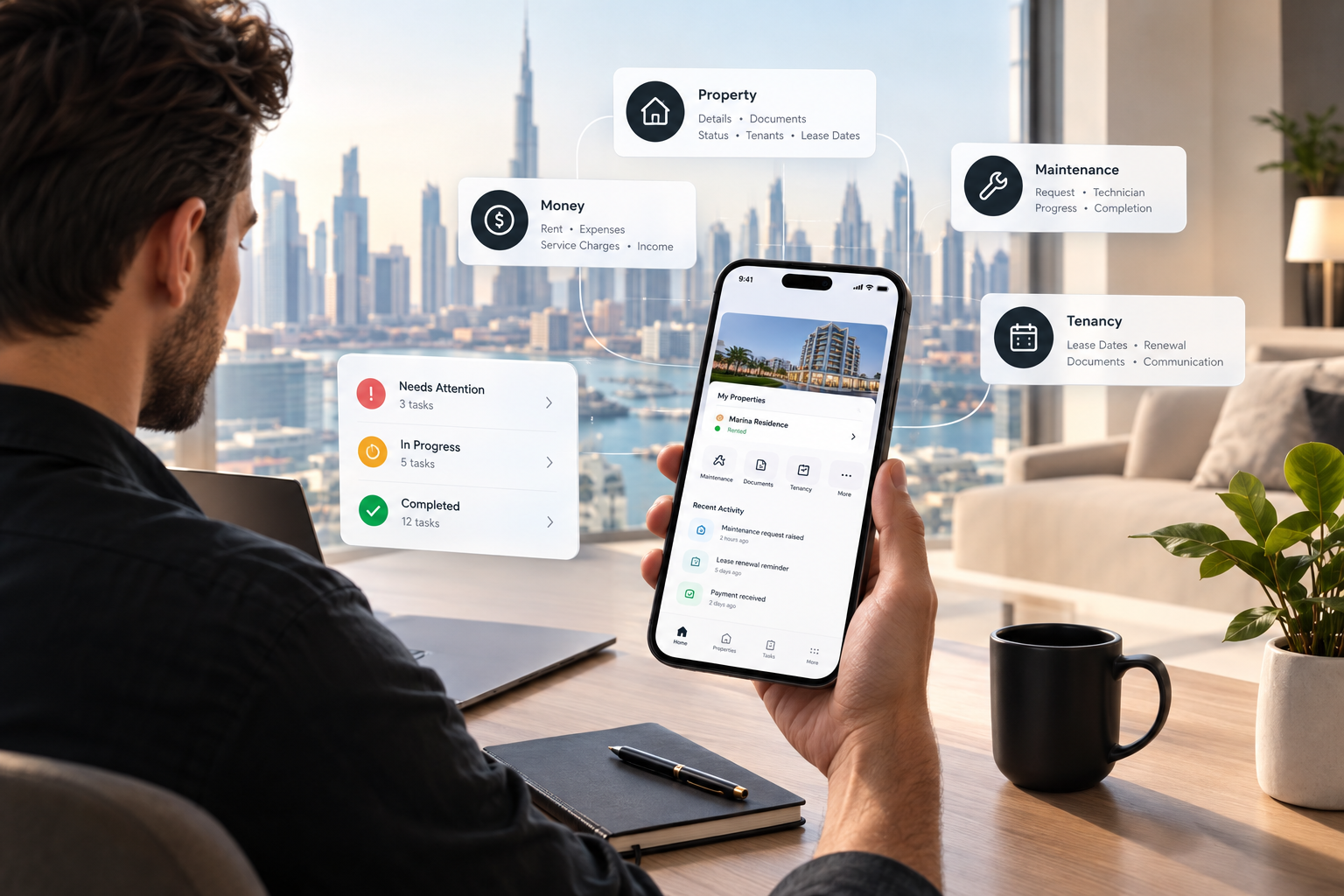
Owning a property is easy to think about in terms of one thing: rent coming in every month.
But a property has a lot happening in the background.
A tenant’s lease may be approaching renewal. A maintenance request might still be open. A document may need updating. A property could be sitting vacant. A broker may have sent an offer. A repair may have been completed — but the invoice still needs checking.
None of these things feels huge on its own.
The problem is what happens when ten small things are happening at the same time.
That is when property ownership starts becoming difficult to keep track of.
The solution isn’t necessarily to work more.
It’s to have a clear system for knowing what is happening, what needs attention and what has already been completed.
One of the easiest mistakes a landlord can make is treating property management as something that only needs attention when there is a problem.
Instead, think of your property as having different areas that need to be monitored.
Keep the basic information easy to access
You shouldn’t have to search through old emails or messages every time you need a basic detail.
Keep an eye on the financial side of the property.
Depending on your situation, this could include:
The point isn’t to obsess over every number. It’s to know whether anything looks unusual.
Maintenance is one of the easiest things to lose track of.
→ A request is made.
→ Someone is contacted.
→ A technician visits.
→ A repair is discussed.
Then the conversation gets buried under everything else happening during the week.
For every maintenance issue, you should be able to answer three simple questions:
What is the problem?| Who is handling it? |Has it been completed?
If you can’t answer those questions quickly, your tracking system needs improvement.
Lease dates shouldn’t be something you remember at the last minute.
Keep track of:
A simple reminder well before an important date can prevent a much bigger problem later.
Efficient property tracking doesn’t mean creating a spreadsheet with 100 columns.
That can actually make things worse.
The goal is to identify the information that helps you make decisions and take action.
For most landlords, that means knowing:
What is happening? | What needs to happen next?
Who is responsible? |When does it need to happen?
That’s enough to create a surprisingly effective system.
Here’s a simple approach that works well.
Instead of writing:
Maintenance issue — bathroom leak
write:
Bathroom leak → technician scheduled → Tuesday → awaiting completion
Now you know the situation immediately.
The same principle works for almost everything.
Lease renewal → contact tenant → 30 days before expiry
Property valuation → request submitted → awaiting report
New tenant → documents required → pending
Broker offer → review offer → decision pending
This turns information into action.
And that is what makes tracking useful.
You don’t need a complicated property management system to start.
Divide everything into three simple categories:
Examples:
~ Maintenance request
~ Lease renewal
~ Unpaid rent
~ Pending document
~ Property inspection
2. In Progress: Things that someone is already handling.
Examples:
~ Technician assigned
~Tenant screening underway
~Valuation requested
~Broker following up with a potential buyer
3. Completed: Things you no longer need to worry about.
Examples:
~Repair completed
~Document submitted
~Lease renewed
~Payment received
This simple system prevents tasks from disappearing into your inbox.
One property can often be managed from memory.
Two or three become harder.
A larger portfolio makes memory almost useless.
Imagine having:
At that point, you don’t just need information.
You need visibility across the portfolio. You should be able to look at your properties and quickly understand:
Which ones need attention?
Which ones are performing well?
Which tasks are overdue?
Which properties have upcoming deadlines?
Where is money being spent?
The more properties you own, the more important a centralized system becomes.
This is where tracking becomes even more important.
If you’re an overseas landlord, you can’t simply visit the property whenever something needs checking.
You depend on communication, professionals and reliable updates.
A good tracking system gives you visibility without requiring you to be physically present.
You should be able to know:
→ What has happened?
→ What is happening now?
→ What needs your decision?
→What has been completed?
Distance shouldn’t mean losing visibility.
One of the biggest causes of property-management chaos isn’t the amount of work.
It’s where the information lives.
Then someone asks:
“What’s the current status of this property?”
And you have to start searching.
That’s when a centralized digital system becomes useful.
Instead of remembering where everything is, you have one place to check.
This is one of the practical reasons a digital property-management platform can be useful.
With BSO Club, landlords can manage property-related activities through one digital ecosystem, including property onboarding, maintenance requests, property valuation, Ejari services and connections with registered real estate professionals.
The platform also allows landlords to track offers and property-related tasks through the app.
For someone managing a property — or several properties — the benefit is simple:
Less searching. More visibility.
Good property management isn’t about constantly checking your property.
It’s about being able to check the right information at the right time.
When property details, tasks, documents, maintenance and updates are scattered across different places, even a single property can feel complicated.
When everything is organized, you can spend less time trying to figure out what’s happening — and more time deciding what to do next.
The goal isn’t to manage more.
It’s to manage with more clarity.
.avif)
.avif)
.avif)
.avif)
.avif)
.avif)
.avif)
.avif)
.avif)
.avif)
.avif)
.avif)

.avif)
.avif)
.avif)
.avif)

.avif)
.avif)

Professional property management in Dubai has been taken to a new standard by BSO® (Be Simply Organized), which provides UAE landlords with outstanding opportunities.
Download BSO Club now!