MAIN MENU
SEARCH
Services

Landlords

Tenants

Brokers

Vendors



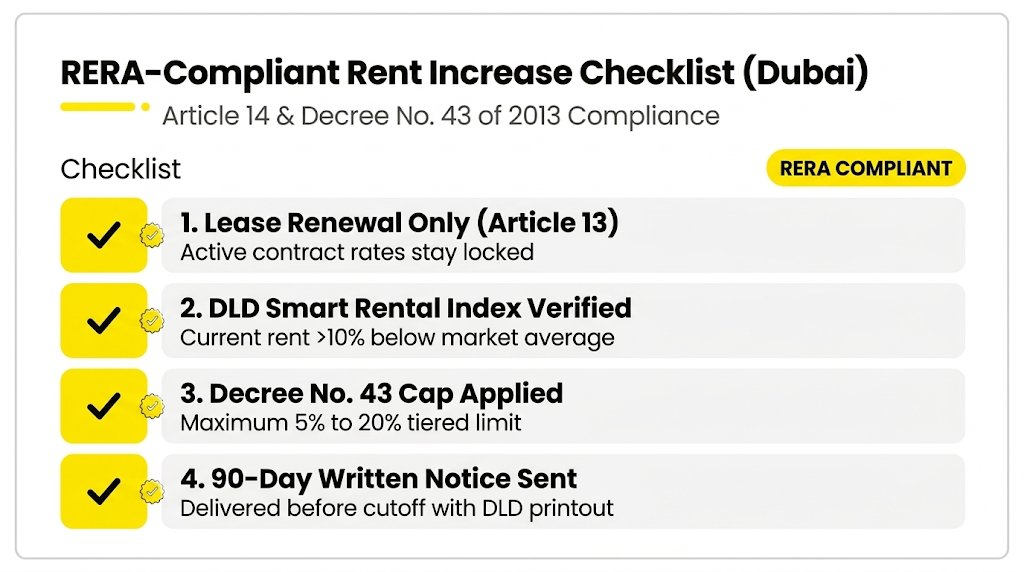
Quick Answer: Yes. Landlords in Dubai can increase rent when renewing a tenancy contract, provided the increase falls within the statutory caps set by Decree No. 43 of 2013 and reflects the Dubai Land Department (DLD) Smart Rental Index. Permitted increases range from 0% to 20%, depending on how far the current rent sits below the official index average for comparable units. Under Article 14 of Law No. 26 of 2007 (as amended by Law No. 33 of 2008), either party wishing to amend tenancy terms—including rent—must notify the other in writing at least 90 days before the contract expires, unless a different notice period was agreed in the contract.
Meeting both requirements—index eligibility and timely written notice—is mandatory. Checking the DLD calculator early and serving documented notice before the 90-day cutoff prevents renewal disputes and protects enforceability.

Yes, landlords can propose a rent increase upon tenancy renewal, provided the adjustment complies with Dubai tenancy legislation and the official rental index. A landlord cannot raise rent mid-contract during an active fixed-term lease simply because market rates have moved.
Two core statutory provisions govern renewal adjustments:
Legal reference: Articles 9, 13, and 14 of Dubai Law No. 26 of 2007, as amended by Law No. 33 of 2008.
Maximum renewal increases are capped by Article 1 of Decree No. 43 of 2013, which establishes five brackets based on the percentage gap between the tenant's current annual rent and the official average market rental rate:
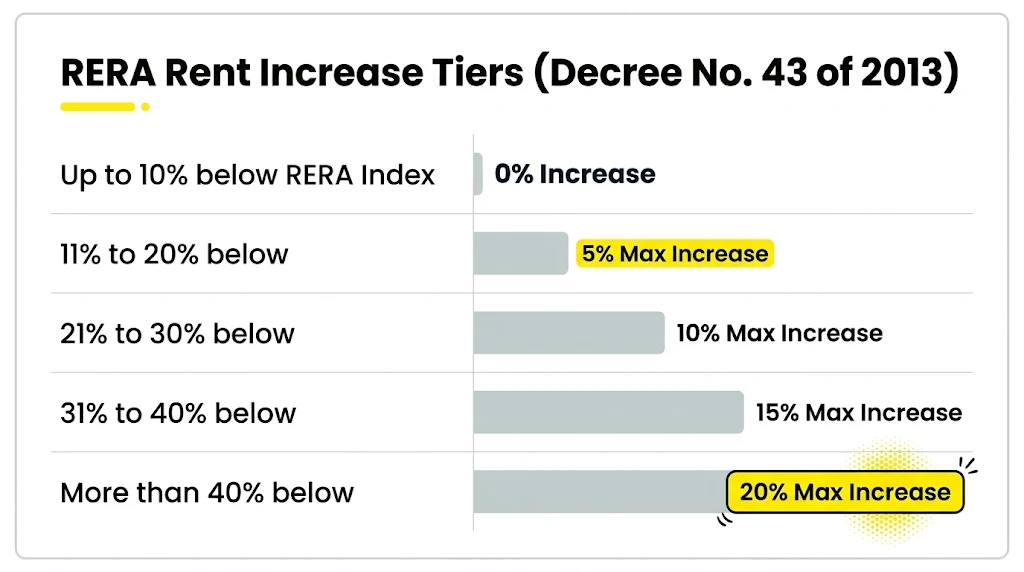
These figures represent statutory ceilings, not automatic entitlements. Even if a unit qualifies for a 10% or 15% adjustment, the landlord must still serve proper notice within the required timeframe.
Suppose an apartment currently rents for AED 90,000 per year, and the DLD Smart Rental Index lists the benchmark average for comparable units in that building at AED 115,000:
(Note: The percentage cap is always applied to the existing contract rent—not used to jump directly to the index average in a single renewal.)
Introduced by the Dubai Land Department on 2 January 2025, the Smart Rental Index replaced area-wide averages with an AI-assisted, building-level classification model. Rather than relying on asking prices advertised on property portals, the index evaluates registered Ejari contracts alongside specific building standards, including:
Because each residential tower is rated individually, two buildings on the same street can generate different benchmark averages. In line with Dubai Land Department (DLD) guidance, the Smart Rental Index and Decree No. 43 rental caps apply across residential areas in Dubai, including free zones and special development zones—excluding the Dubai International Financial Centre (DIFC), which is governed independently under its own separate common-law framework (DIFC Law No. 1 of 2020) and adjudicated by the DIFC Courts rather than RERA or the Rental Disputes Center (RDC).
dubailand.gov.ae) or the Dubai REST app.Official source: Dubai Land Department – Smart Rental Index announcement (2 January 2025).
Under Article 14 of Law No. 26 of 2007 (as amended by Law No. 33 of 2008), a landlord must notify the tenant at least 90 days before the lease expiry date to amend rent or contract terms, unless the tenancy contract explicitly specifies another notice period.
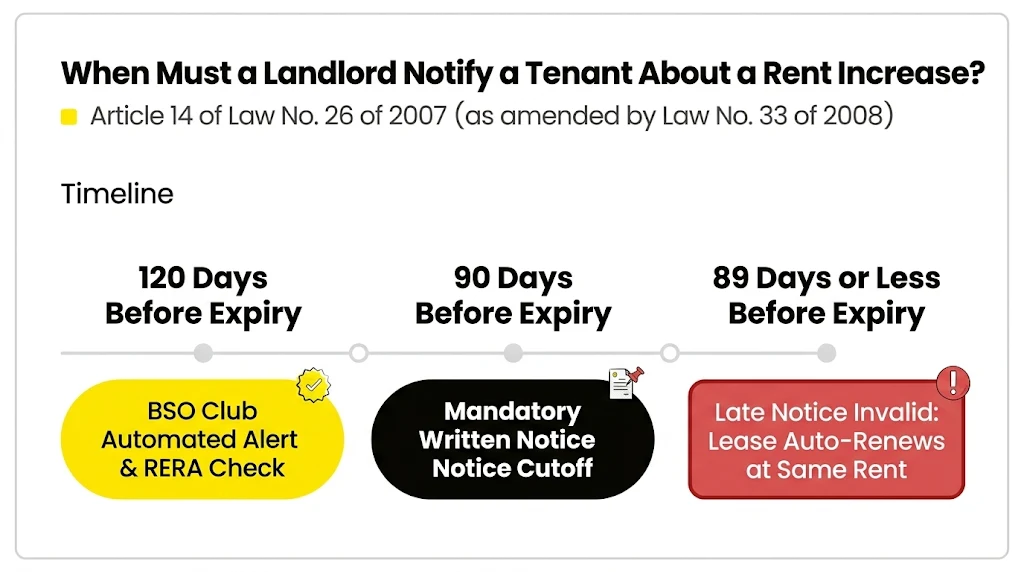
If a landlord fails to serve valid notice at least 90 days before expiry (and no shorter notice period was agreed in the contract), the landlord loses the right to enforce a rent increase for that renewal cycle. Under Article 6 of Law No. 26 of 2007, if a lease expires and the tenant remains in the property without valid objection, the tenancy automatically renews for the same duration or one year (whichever is shorter) under the exact same terms and rent.
Legal reference: Articles 6 and 14 of Dubai Law No. 26 of 2007, as amended.
A rent increase notice must be delivered in writing with verifiable proof of transmission and receipt. Under Article 2 of the amended Dubai Tenancy Law, formal notices may be served via Notary Public, registered mail, hand delivery with signed acknowledgement, or approved electronic means.
Under guidance from the Rental Disputes Center (RDC), electronic communications—including email and WhatsApp messages—can be admitted as supporting evidence in rental disputes when their authenticity is established (for example, through reciprocal replies or party acknowledgement in the case record).
However, relying solely on an unacknowledged WhatsApp message carries risk if a tenant disputes receipt. Landlords should send renewal notices via the tenant's contractually registered email address (and registered mail or Notary Public where disputes are anticipated) so delivery is beyond doubt.
Official source: Rental Disputes Center (RDC) – Frequently Asked Questions.
Managing renewals across one or multiple Dubai properties requires coordinating index checks, statutory deadlines, tenant correspondence, and Ejari filings without letting dates slip.
Tracking 90-day statutory notice windows, storing Ejari certificates, and logging written tenant communications across multiple units quickly becomes error-prone when managed manually through spreadsheets and personal emails.
The BSO Club App, developed and operated by BSO Real Estate Management in Dubai, centralizes residential and commercial portfolio operations into a single digital workspace for landlords, property investors, and RERA-licensed brokers. Specifically, landlords use the platform to:
Only if the DLD Smart Rental Index confirms the current rent is more than 10% below the building's benchmark average and the landlord serves valid written notice at least 90 days before expiry. Rent increases are not automatic each year.
Yes, if the existing rent is 21% to 30% below the official DLD Smart Rental Index average for comparable units and the landlord complies with the 90-day written notice requirement.
No. Rent is fixed for the duration of an active lease term and can only be adjusted upon renewal in accordance with Article 13 and Article 14 of Law No. 26 of 2007 (as amended).
Unless the contract specifies a different notice period, the landlord cannot impose a rent increase for that renewal. The contract renews on the same rent and terms.
WhatsApp messages may be accepted as supporting evidence by the Rental Disputes Center if authenticity and receipt are established, but landlords should always send formal renewal notices via registered email or Notary Public to ensure indisputable proof of delivery
No. These are separate legal procedures under Dubai tenancy law:


BSO Club brings Landlords, Tenants, Buyers, Brokers and Vendors into one app. Search, book viewings, make offers, find tenants, sellers or buyers and sign contracts from your phone. Free to join, ready in a minute.




Professional property management in Dubai has been taken to a new standard by BSO® (Be Simply Organized), which provides UAE landlords with outstanding opportunities.